



In the silent hum of a factory, on the thermostat in your living room, within the unseen depths of a modern city—IoT and embedded systems have woven themselves into the fabric of existence. They measure, automate, warn, heal, and, crucially, connect. But every connection, every protocol, every cloud intermediary is both a lifeline and a gateway for adversarial intent.
Threat modeling is the art and science of anticipating these adversaries: of mapping out what could go awry before it ever does. And in the world of IoT and embedded systems, it’s the last line of defense between innovation and exploitation.
I. Why IoT Threat Modeling Demands Nuanced Strategy
- Unprecedented Attack Surface: IoT systems sprawl across physical, radio, and cloud domains—each introducing unique vulnerabilities and trust boundaries.
- Resource Constraints: Devices designed for efficiency often lack robust cryptography, patching, or even logging.
- Longevity and Interdependencies: A sensor deployed today might operate for a decade—potentially outlasting its firmware support, while cloud APIs, protocols, and partner systems evolve rapidly.
- Privacy and Safety Duality: Breaches impact not just data, but people’s physical environments and lives.
II. A Tale of Two IoT Ecosystems
A. Enterprise IoT (Smart Manufacturing, Critical Infrastructure)
Imagine a global manufacturer:
- Thousands of ruggedized sensors and actuators monitor machinery, energy, and safety.
- Devices relay data via hardened gateways, which connect through VPN to a secure, segmented GCP infrastructure.
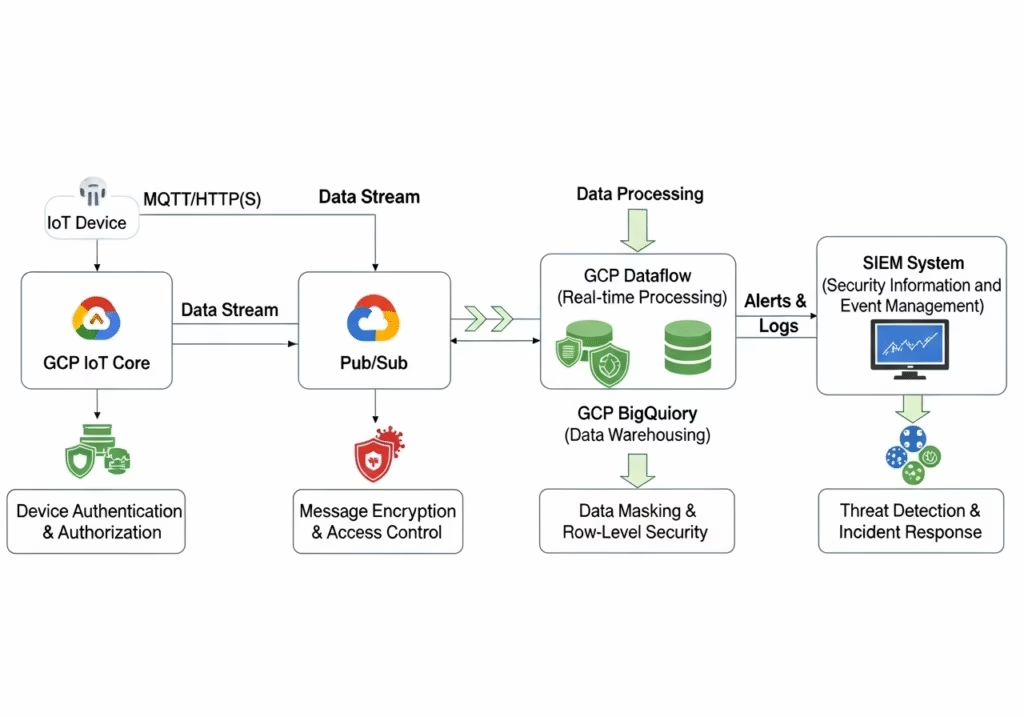
- Within GCP, Cloud IoT Core authenticates devices, Pub/Sub synchronizes real-time telemetry, Dataflow analyzes anomalies, BigQuery stores and correlates, and advanced SIEM monitors for signals of compromise.
Risks:
- Hardware spoofing, rogue firmware injections, event stream manipulations, privilege escalation via misconfigured IAM, and supply chain contamination—all magnified by the pace and scale of automation.

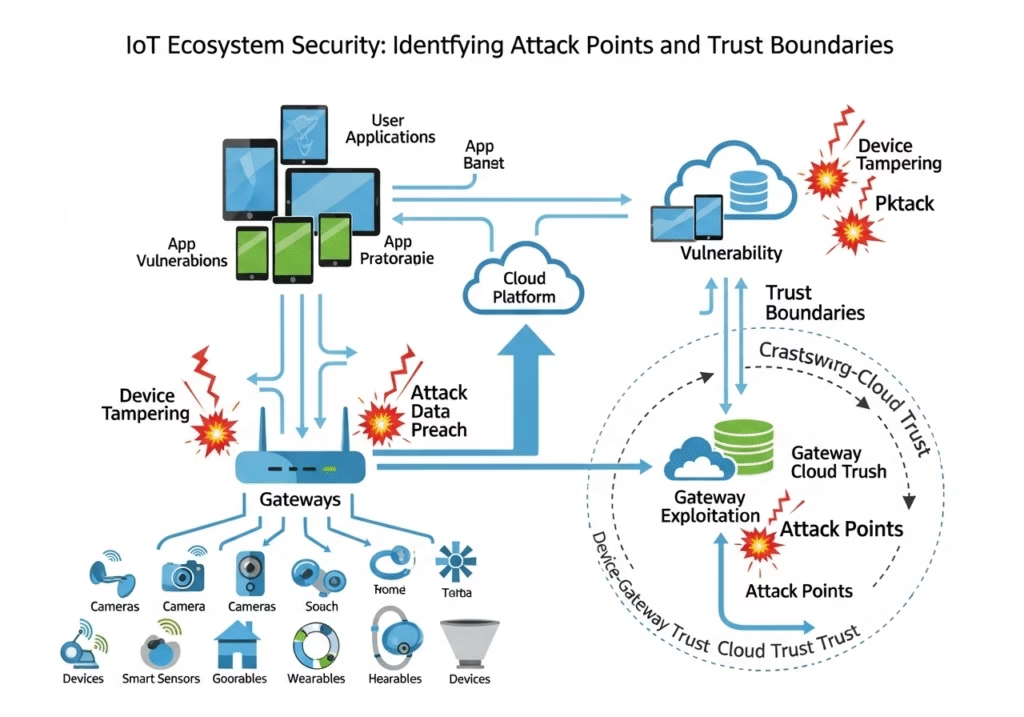
B. Consumer IoT (Smart Homes, Wearables, Connected Appliances)
Picture a modern home:
- Thermostats, cameras, and sensors speak to the cloud via a WiFi router and HTTPS APIs.
- GCP Pub/Sub pushes updates, Firebase backs up settings, mobile apps empower user control.
- Privacy becomes paramount: everything from sleep patterns to room temperature, now digitized.
Risks:
- Botnet herding, privacy leakage, unencrypted traffic on home networks, insecure mobile interfaces, and even physical security impacts from device compromise.
III. Cloud as Intermediary: The Promise and Peril of GCP
Intermediaries like GCP Pub/Sub are the heart of modern IoT solutions. They decouple devices from apps, scale event delivery, and promise resilience. But consider:
- IAM roles: A single misconfiguration can unlock access across thousands of devices and topics.
- Device authentication: Certificate onboarding is vital; password-based schemes are perilously weak.
- Event trust: An attacker publishing a rogue event could trigger malicious device behaviors or misleading analytics.
- Data at rest and in transit: Storage solutions (BigQuery/Firebase) must be segmented, audited, and minimized for exposure.
“In IoT, every cloud is a new trust boundary—model it, control it, and question it.”
IV. The Arsenal: Best Frameworks, Wisely Combined
STRIDE:
Classic yet potent—Spoofing, Tampering, Repudiation, Information Disclosure, Denial of Service, Elevation of Privilege.
Apply for every interface: hardware, cloud API, mobile app, analytics system.
MITRE ATT&CK (ICS/IoT):
The map to the adversary’s mind.
Use for mapping known tactics (lateral movement, credential theft, protocol abuse) along every data path.
IEC 62443:
The industrial gold standard.
Adopt for segmenting devices, gateways, clouds into security zones and measuring each by defined security levels.
LINDDUN:
The guardian of privacy.
Invoke when smart homes and wearables process personal data—identify unawareness, linkage, unauthorized detection.
OCTAVE:
Think beyond the device—understand risk by consequence, not just by technicality.
Model threats that cascade across business operations, regulatory landscapes, and reputation.
The wisdom is in not choosing one, but layering them: the technical clarity of STRIDE, the adversarial reality of ATT&CK, the compliance force of IEC 62443, the privacy lens of LINDDUN, and the operational depth of OCTAVE.
V. How to Threat Model—Comprehensively
1. Asset and Surface Mapping:
List every device, protocol, cloud endpoint, firmware, and human interface. Plan for change—the ecosystem will evolve.
2. Data Flow Diagrams (DFDs):
Visualize every path, from sensor wire to cloud dashboard. Mark trust boundaries, encryption milestones, and weakest links.
3. Threat Enumeration:
Use frameworks methodically—pose every “what if?” at every hop. Model rogue endpoints, spoofed events, lost logs, breached privacy, compromised firmware, and abused cloud roles.
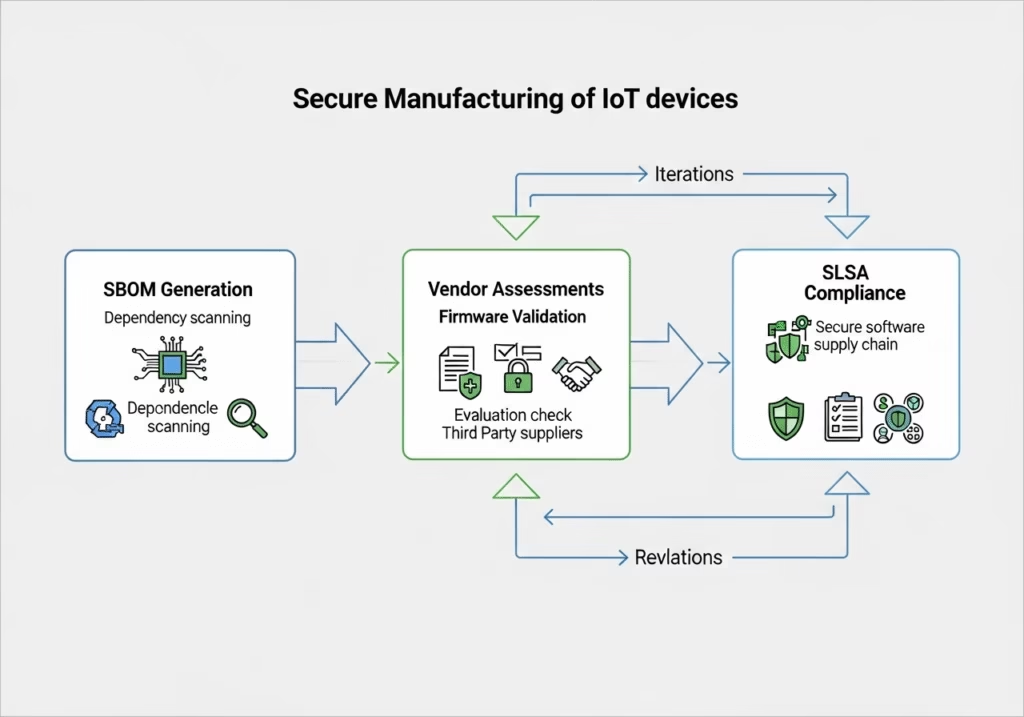
4. Supply Chain Analysis:
Demand SBOMs from vendors, validate firmware provenance, enforce SLSA practices for all third-party code and cloud images.
5. Risk Quantification:
Score with DREAD/CVSS. Overlay business impact: consider not just data, but safety, privacy, continuity, and compliance.
6. Mitigation and Defense-in-Depth:
Deploy end-to-end encryption, certificate-based device authentication, strict IAM for cloud resources, segmented pub/sub topics, rigorous update policies, and anomaly detection.
7. Continuous Validation, Testing, and Monitoring:
Penetration test every logical perimeter—simulate device and cloud API compromise, red team with adversarial techniques from ATT&CK.
Monitor, alert, and audit—malicious events often hide in plain sight.
8. Privacy and User Awareness:
Make opt-ins, data minimization, and user education a first-class part of your threat model—especially for consumer IoT.
VI. The Future and Supply Chain Realities
IoT security isn’t just about endpoints; it’s about every part of the journey—assets, supply chain, intermediary cloud processes, and data consumers.
- Quantum and AI threats loom—model now for tomorrow’s adversaries.
- Edge computing and mesh networks—new attack surfaces, new trust boundaries.
- Regulatory compliance is moving fast—keep threat models aligned to the changing standards.
Conclusion: The Art of Anticipation
To protect the promise of IoT, embedded computing, and smart homes, we must become relentless cartographers of risk—tracing every line, interrogating every cloud, questioning every boundary.
Threat modeling is where security, privacy, and organizational purpose converge.
It is both map and compass, shield and telescope.
If you are building, deploying, or securing IoT today, ask not just “What does my system do?” but “How might it be undone?”—and then, using the best frameworks and your own informed judgment, secure every possible route of attack and compromise.
The invisible world of IoT deserves a guardian. Let that guardian be threat modeling—layered, eloquent, and unyielding.
References
- https://ieeexplore.ieee.org/document/9993475/
- https://www.iriusrisk.com/resources-blog/capec-threat-modeling
- https://sii.pl/blog/en/threat-modeling-for-cybersecurity-in-embedded-systems/
- https://blog.secureflag.com/2024/09/18/threat-model-cloud-applications-in-aws-azure-gcp/
- https://industrialcyber.co/control-device-security/mitre-releases-enhanced-emb3d-threat-model-with-new-mitigations-isa-iec-62443-4-2-alignment/
- https://www.securitycompass.com/blog/everything-you-need-to-know-about-iec-62443/
- https://www.iriusrisk.com/resources-blog/octave-threat-modeling-methodologies
- https://link.springer.com/10.1007/978-3-031-74443-3_16
- https://ieeexplore.ieee.org/document/10639949/
- https://www.infosecinstitute.com/resources/cissp/threat-modeling/
- https://arxiv.org/abs/2506.06478
- https://www.isa.org/standards-and-publications/isa-standards/isa-iec-62443-series-of-standards